

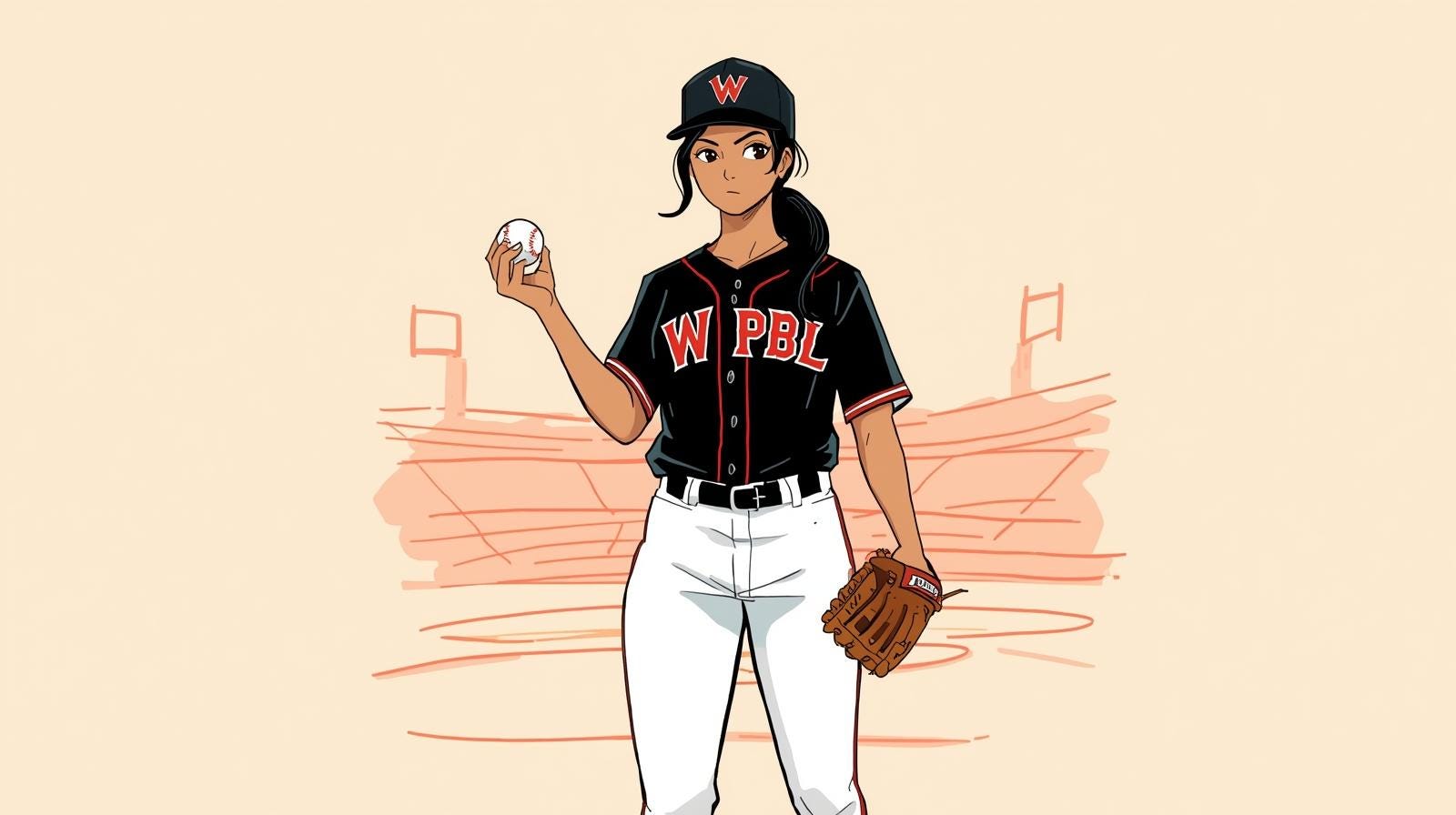
The launch of the WPBL is significant. Not symbolic. Significant. A professional women’s baseball league operating on American soil is not a novelty story. It is a business story. And like any business, it deserves to be evaluated honestly. Only then can we see if this dream will be a part of our reality and not another footnote in the history of women’s baseball.
From the outside looking in, the most pressing question is financial sustainability.
The league salary cap is $95,000 dollars per team. With 15 players per roster, that works out to roughly $6,333 dollars per player for the entire seven week season. Over approximately 40 games, that is about $904 dollars per week or $158 dollars per game.
Many players are supplementing their income with sponsorships. Mo’ne Davis, for example, is backed by Wilson Sporting Goods for the WPBL season, while just yesterday Emi Saiki announced a deal with Tadano Co., based in her hometown of Kagawa, Japan. These partnerships show how players are balancing professional aspirations with financial realities, relying on personal endorsements to make participation viable.
Those numbers tell you exactly where this league currently stands. Players are not here for salary. They are here because they believe in what this could and should become.
Startup leagues rarely open with large payrolls. The early years of the WNBA required heavy financial backing from the NBA. Growth took time and institutional support. Even now, women’s professional leagues operate on tighter margins than their male counterparts.
The difference is backing.
The WPBL does not currently have a formal financial partnership with Major League Baseball. There have been encouraging moments. Batting practice opportunities with the Boston Red Sox at Fenway Park. Draft tryouts tied to the Washington Nationals. Those relationships create exposure. They do not create financial stability.
When MLB directed funding toward women’s diamond sports last year, support went to the Athletes Unlimited Softball League. That does not diminish what the WPBL is building, but it does reinforce that there is no major institutional safety net here. It also signals that at that point in time, MLB did not yet see enough infrastructure set in place for a women’s league in order to invest in it for the long term.

Meanwhile, the broader baseball market continues to show what sells. The Savannah Bananas have built a thriving brand around entertainment driven baseball. Spectacle generates revenue quickly. Traditional competition, especially on the women’s side, historically grows slower. That is not commentary on quality. It is commentary on market behavior.
There is another piece of the financial picture that deserves attention. The league is relying on unpaid interns, many of whom will receive college credit. That experience may be valuable. But unpaid labor in the middle of summer, during a compressed seven week season that hopes to draw record crowds, raises real questions. If the league expects professional level execution on game days, even a modest stipend would signal that everyone involved is being valued for their time. Every dollar counts, and relying on unpaid labor highlights just how lean the operation is.

The single entity ownership model centralizes decision making and prevents overspending. It also concentrates the risk. If revenue projections fall short, the league absorbs it. There are no independent owners operating separately to offset losses.
None of this guarantees failure. It simply underscores how thin the margins are.
A formal partnership with Major League Baseball would change the equation. Shared marketing, shared facilities, sponsorship leverage, and direct capital would extend the runway significantly. Without that, growth depends heavily on ticket sales, sponsorship traction, and media reach accelerating quickly.
The WPBL has structure. It has athletes willing to invest their time and talent. It has momentum. What it does not yet have is financial cushion. There is no doubt in my mind that Justine Siegal and the other co-founders are working tirelessly to do everything in their power to make this happen. The problem isn’t making it happen. The problem is making it last.
This is not a question of whether women’s baseball belongs. It does. The real question is whether the business framework around the WPBL is strong enough to sustain it long term.
I’m excited for this first season regardless. I do hope it can stick around! It’s a big swing (pun intended) but if it does well who knows where it could lead. It might take a miracle, but miracles do happen in the sports world from time to time. They need to catch lightning, and enough people need to see them do it.
I’m hoping to attend at least a couple of games, if they don’t sell out before I get the chance. But I guess that would be its own kind of win.
To quote Han Solo, I've got a bad feeling about this. One of my nerdy sports niches is the history of failed leagues and teams, and this kind of penny-pinching isn't giving me a lot of confidence. Starting a sports league is going to burn through money.
I will still cheer for the women when they play, but I can't help thinking of women's hockey, and the numerous leagues it took to find some stability. I hope baseball is able to learn from those experiences.